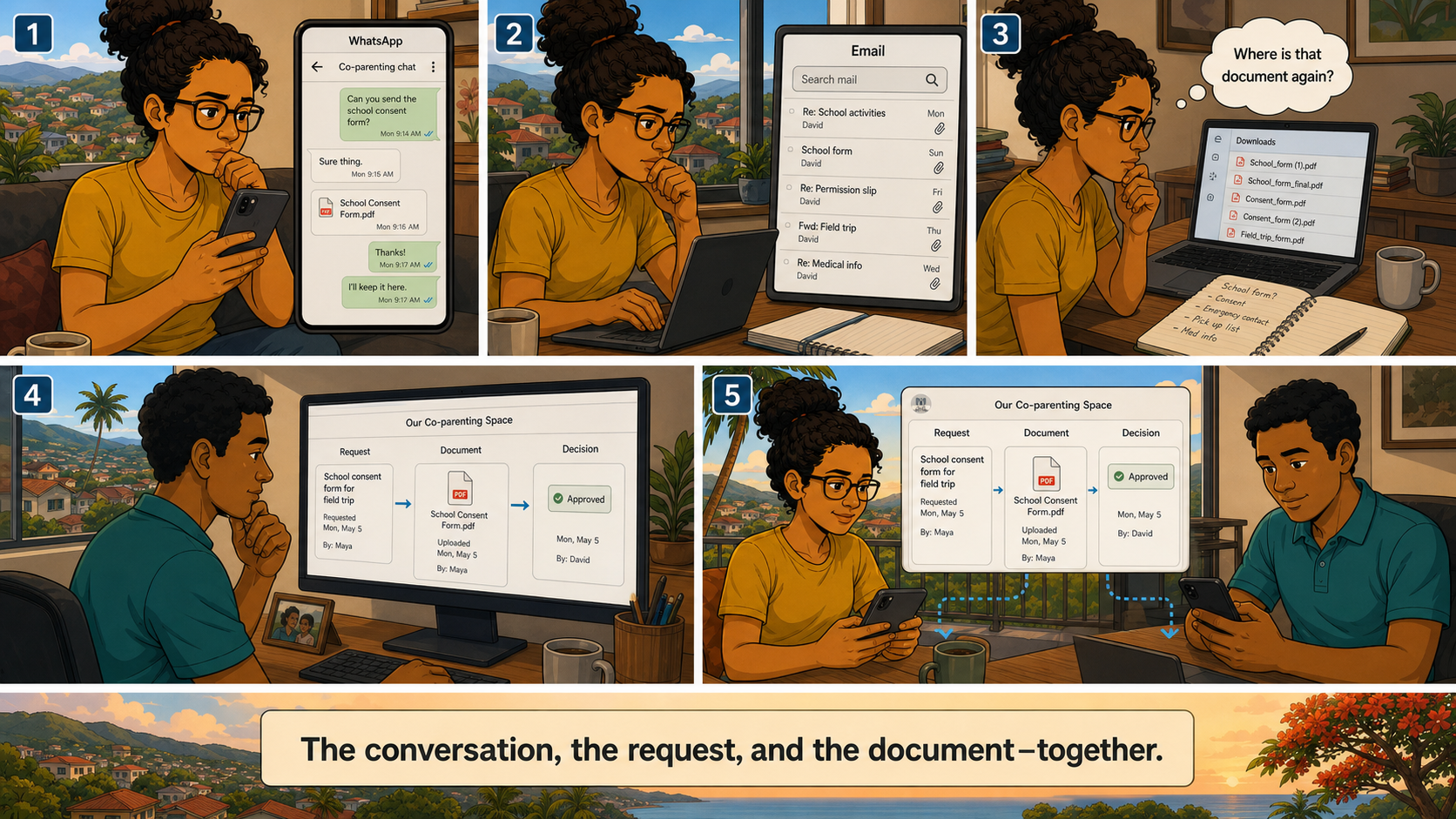
A parent needs to find one important document.
They scroll through a WhatsApp conversation, then an email thread, then they check the downloads folder and even an old notebook.
Where is that document again?
Although the document may have been sent, the problem is finding it, remembering which version is current and reconnecting it to the decision it supported.
WhatsApp and email can help parents communicate. But communication is only one part of co-parenting.
A messaging system does not automatically connect what was said to what was decided or what happens next.
Is WhatsApp enough for co-parenting?
WhatsApp is familiar, convenient and useful for quick updates.
Parents may use it to confirm pickup, share a school notice or ask whether an appointment has been scheduled. For simple arrangements, that may be enough.
The difficulty arises when a conversation includes several subjects at once.
A schedule change may be discussed alongside unrelated messages. A document may be attached to one part of the conversation but needed weeks later. A decision may be agreed in one message and clarified in another.
Over time, finding the complete context can require scrolling, searching and trying to remember what happened.
WhatsApp is designed to help people exchange messages. It is not designed to connect every message to a request, schedule, document or an outcome.
What about email?
Email can be useful when a message needs more explanation or includes attachments.
It is searchable, and parents may already use it for school notices, receipts and formal communication.
But email can create a different kind of separation.
The conversation sits in the inbox while other parts sit somewhere else. The document may be downloaded, forwarded or saved somewhere else. The final decision may be buried inside a long thread.
Email helps preserve communication, but it does not automatically turn that communication into a shared plan with shared context.
What about a shared calendar?
A shared calendar can solve one important part of co-parenting: visibility.
Both parents can see school events, appointments, activities and parenting time in one place.
A calendar entry, however, does not always explain the decision behind it or provide the full context.
Who requested the event or change?
Did both parents agree to it?
What documents are required?
What am I expected to contribute?
What happens if one parent cannot follow the plan?
A calendar is useful. It is not the entire system.
The difference between a conversation and a system
Ordinary communication tools are organised around messages.
Co-parenting responsibilities are organised around decisions and schedules.
A decision may involve a conversation, a request, a response, a schedule change, a document or receipt, and a clear outcome or plan.
When these pieces remain separate, parents may need to reconstruct the story later.
A co-parenting system connects them as they happen.
The conversation can explain the context.
The request can identify what needs a decision.
The calendar can show when it applies.
The document can provide supporting information.
The outcome can remain connected to the history.
That structure reduces the need to search across several tools and remember which version of the information is current.
Who can benefit from a co-parenting system?
You do not need to be in conflict to benefit from more structure.
A co-parenting system can help parents who:
Live in separate homes and want both households working from the same information.
Are coordinating school, activities, appointments, transport and everyday responsibilities.
Communicate respectfully but still lose important details in messages or email.
Want children to stay out of the middle of adult planning.
Prefer clear requests, decisions and follow-through.
Want important documents, schedules and conversations connected in one place.
Have changing work commitments or busy family calendars.
Value shared information about their children and want to stay involved across both homes.
Want a calmer, more organised way to manage the practical parts of family life.
Zuko was designed for parents who want co-parenting to feel clearer, more connected and easier to manage—whether their schedules are simple or constantly changing.
A quick update can remain a quick update. A decision that affects both homes can become a request. A document can stay connected to the responsibility it supports.
A better system does not mean you abandon familiar tools
WhatsApp and email can still have a place in everyday co-parenting. The goal is not to eliminate every familiar channel or make every interaction formal.
The goal is to give important co-parenting information a clear home.
When communication, requests, schedules, documents and records work together, parents spend less time searching and more time understanding what needs attention.
That is the need Zuko was designed to support: one connected co-parenting workspace that keeps the practical parts of family life easier to see, follow and revisit.